

Home > Our Services >

How is AI being used in life sciences?
AI is being used in life sciences to improve speed, accuracy, and automation across research, clinical, and operational workflows. Machine learning helps organizations identify patterns in complex data, predict outcomes, and support faster decision-making. Generative AI is being used to summarize information, assist with documentation, and help teams work more efficiently across systems and knowledge sources. Agentic AI is the next step, allowing AI to take action across workflows with less manual input. As these technologies mature, life sciences companies are moving beyond proofs of concept and into production, focusing on secure, scalable, and compliant ways to apply AI in real-world environments.
Need more detail? Read the AI for Life Sciences FAQ fact sheet.
AI Use Cases in Life Sciences
Accelerating biotech and life sciences breakthroughs with AI-driven automation, Bedrock solutions, and data-intelligent workflows built for discovery.


AI Strategy for Regulated Life Sciences
The AI Problems We Solve
AI in life sciences can accelerate research, improve documentation, streamline operations, and help teams make faster decisions. But moving from AI promise to production-ready value requires the right data strategy, AWS architecture, security model, governance, and support.
PTP helps biotech, pharma, and clinical research teams identify practical AI use cases, design secure AWS AI environments, and move from proofs of concept to scalable solutions that support regulated life sciences workflows.
Turning AI Promise Into Production
Many life sciences teams know AI can help, but struggle to move beyond experiments, pilots, or disconnected tools. PTP helps translate AI ideas into production-ready workflows with clear use cases, secure infrastructure, and measurable outcomes.
Managing Data Complexity and Compliance
Research, clinical, and operational data is often fragmented across systems, teams, and environments. PTP helps life sciences organizations build AI-ready foundations that account for security, governance, compliance alignment, and data access controls.
Choosing the Right AI and AWS Architecture
The wrong AI approach can create unnecessary cost, security risk, technical debt, or compliance concerns. PTP helps teams evaluate AWS services, architecture patterns, and implementation paths that fit regulated life sciences environments.
Proving AI ROI Quickly
Startups and Series A/B life sciences companies need to show value without wasting time or budget. PTP helps prioritize focused AI use cases, build practical proofs of concept, and create a path to ROI before scaling investment.
Featured Playbook
Agentic AI for Biotech Research and Compliance
PTP’s agentic AI playbook explains how biotech and life sciences organizations can move beyond basic chatbots and build secure, governed AI workflows for research, documentation, compliance, and AWS-based infrastructure.
- Learn how agentic AI supports multi-step research and compliance workflows.
- Explore governance, data access, auditability, and human review requirements.
- See practical use cases including biomarker discovery, genomic analysis, clinical trial protocol drafting, and FDA submission support.
Inside the PDF
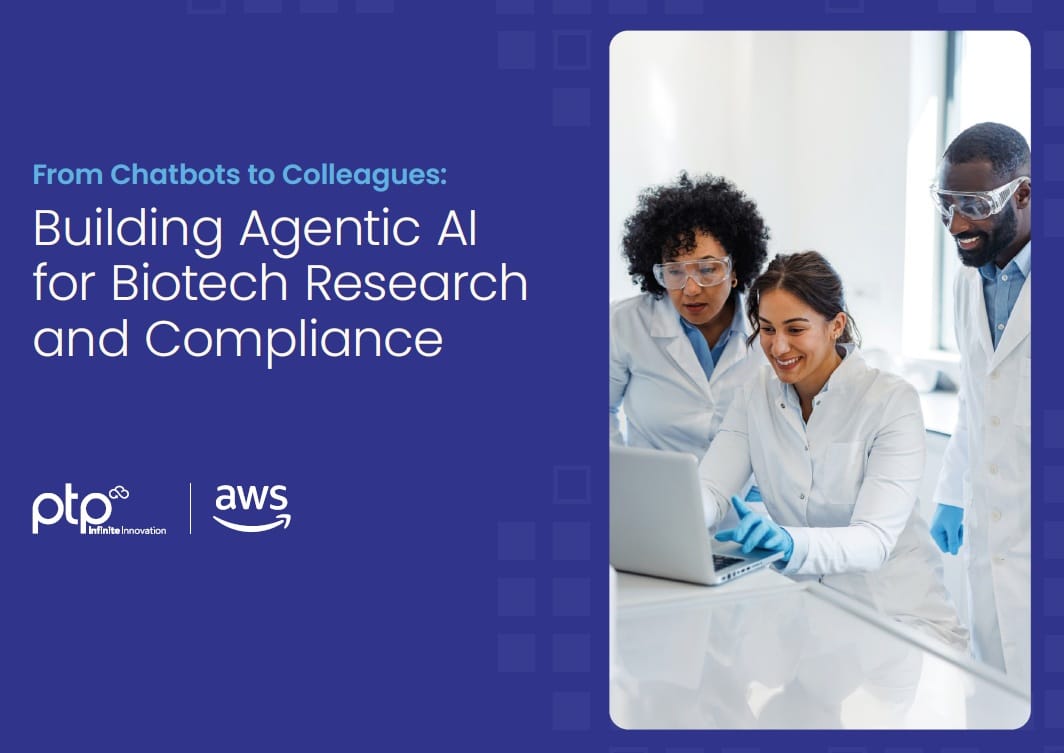
From Chatbots to Colleagues: Building Agentic AI for Biotech Research and Compliance
PDF Playbook
PTP is an AWS Certified AI Practitioner
As an AWS Partner with the AI Services Competency, PTP helps biotech organizations accelerate innovation through no-cost Proofs of Concept (PoCs) funded by the AWS PoC Program.
This initiative allows qualified life sciences clients to experiment with AI, ML, GenAI, and Agentic AI, without upfront costs, by leveraging AWS and PTP’s expert engineering guidance.
PTP helps biotech and research organizations harness the power of AI to accelerate discovery and decision-making. By leveraging AWS services such as SageMaker, Bedrock, and Amazon Q, PTP enables scientists to analyze complex datasets, automate documentation, and streamline experimental workflows securely and at scale.
AI in Pharma and Biotech for Every Stage of Growth
Early-Stage Biotech
Growth-Stage Biotech
Commercial Life Sciences
Early-Stage Biotech Companies for AI
Early-stage life sciences companies can use AI to accelerate discovery, organize research data, automate documentation, and support lean teams without adding unnecessary operational complexity. PTP helps biotech startups design secure AI and GenAI foundations using AWS services such as Amazon Bedrock, SageMaker, and Amazon Q, so scientists can experiment faster, improve decision-making, and build scalable workflows from the beginning.
| Early-Stage Challenges | PTP Solutions |
|---|---|
|
CEOs and Founders
We need to prove AI value without wasting time or budget. |
PTP helps early-stage biotech teams identify practical AI use cases, build focused proofs of concept, and move toward production-ready solutions using secure AWS AI services. |
|
CTOs and IT Directors
We need the right AI architecture from the start. |
PTP designs scalable AWS AI foundations using services such as Amazon Bedrock, SageMaker, and secure cloud infrastructure, helping teams avoid rework and reduce technical debt. |
|
CFOs Evaluating Technology Investments
We need to show AI ROI before costs grow. |
PTP helps prioritize AI use cases with measurable outcomes, cost visibility, and right-sized AWS architecture, so leadership can evaluate impact before scaling investment. |
|
VP/Directors of R&D
We need AI to turn complex research data into usable insights. |
PTP helps R&D teams apply AI to scientific data workflows, documentation, and analysis so researchers can accelerate discovery without becoming infrastructure experts. |
|
Head of Operations and Facilities
We need AI tools without added security or support risk. |
PTP helps operational teams deploy secure, manageable AI workflows with the right governance, support model, and AWS foundation in place from the beginning. |
Growth-Stage Biotech Companies for AI
Growth-stage biotech companies need AI systems that can support larger datasets, expanding research teams, clinical preparation, and more complex operational workflows. PTP helps life sciences organizations apply AI, ML, GenAI, and Agentic AI to research automation, data analysis, regulatory documentation, and scientific collaboration while keeping security, governance, and scalability at the center of the architecture.
| Growth-Stage Biotech Challenges | How PTP Supports Growth |
|---|---|
|
CEOs and Founders
We need to turn AI pilots into real business value. |
PTP helps growth-stage biotech companies move from AI experiments to production-ready solutions with secure AWS architecture, implementation support, and scalable workflows built for life sciences. |
|
CTOs and IT Directors
We need AI systems that scale without adding complexity. |
PTP provides AWS AI architecture, governance, integration, and managed support to help IT teams scale AI systems as data, users, security needs, and clinical readiness demands increase. |
|
CFOs evaluating tech investments
We need proof that AI investments are paying off. |
PTP connects AI strategy to measurable business outcomes, cloud cost visibility, and phased implementation so teams can prove value before expanding investment. |
|
VP/Directors of R&D
We need AI to support larger datasets and research workflows. |
PTP helps R&D teams use AI, ML, and GenAI to automate research workflows, improve access to data, and accelerate analysis while maintaining security and scalability. |
|
Head of Operations and Facilities
We need AI that supports compliance and daily operations. |
PTP helps implement governed AI workflows and AWS environments that support security, reliability, compliance alignment, and operational readiness as the organization grows. |
Commercial Life Science Companies for AI
Commercial life sciences organizations use AI to improve efficiency across research, clinical, quality, manufacturing, regulatory, and commercial operations. PTP helps enterprise teams deploy secure and governed AI solutions that automate repetitive work, improve access to scientific and operational data, support regulated workflows, and help teams make faster decisions without disrupting business-critical systems.
| Commercial-Stage Priorities | How PTP Supports Enterprise IT |
|---|---|
|
VPs/Directors of IT
We need governed AI without disrupting critical operations. |
PTP helps commercial life sciences organizations deploy secure, governed AI solutions across complex AWS environments, improving reliability, compliance alignment, and operational consistency across research, quality, manufacturing, and commercial teams. |


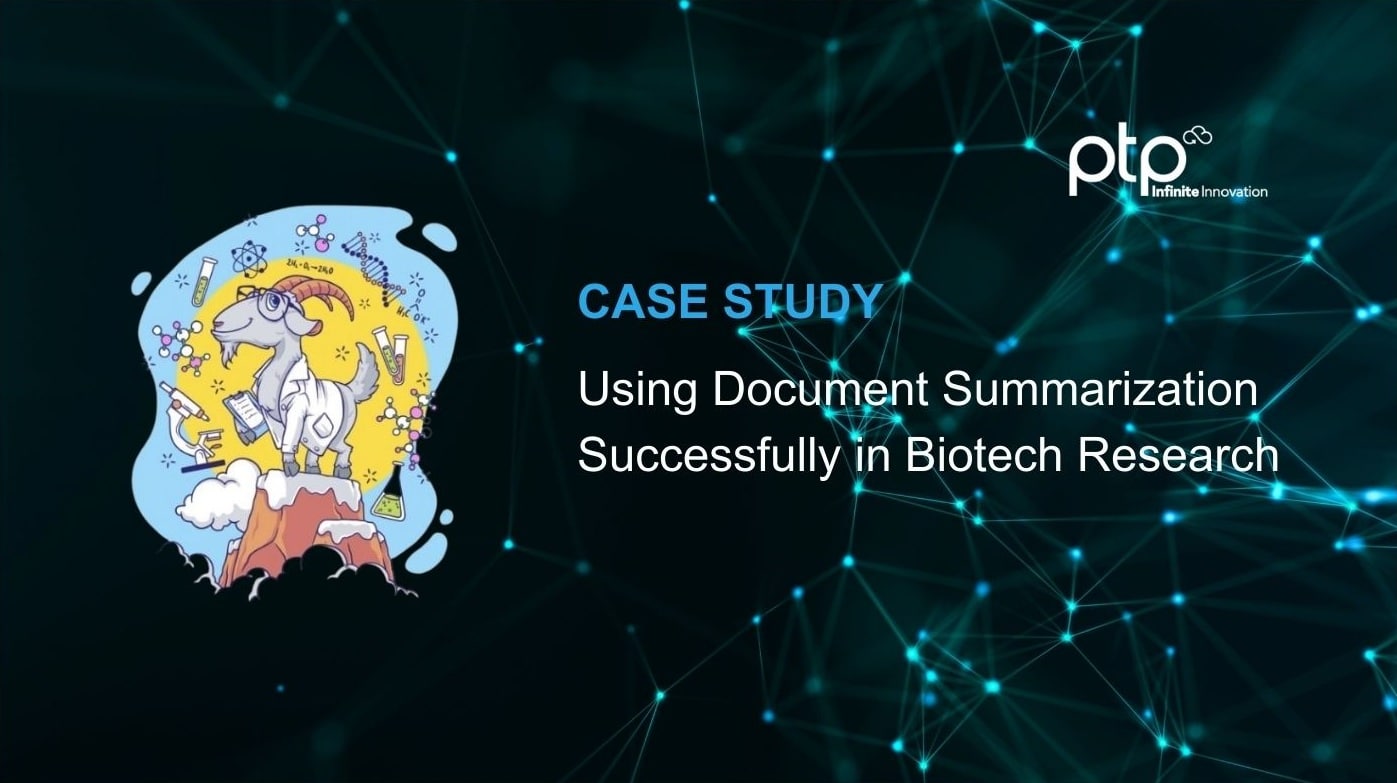
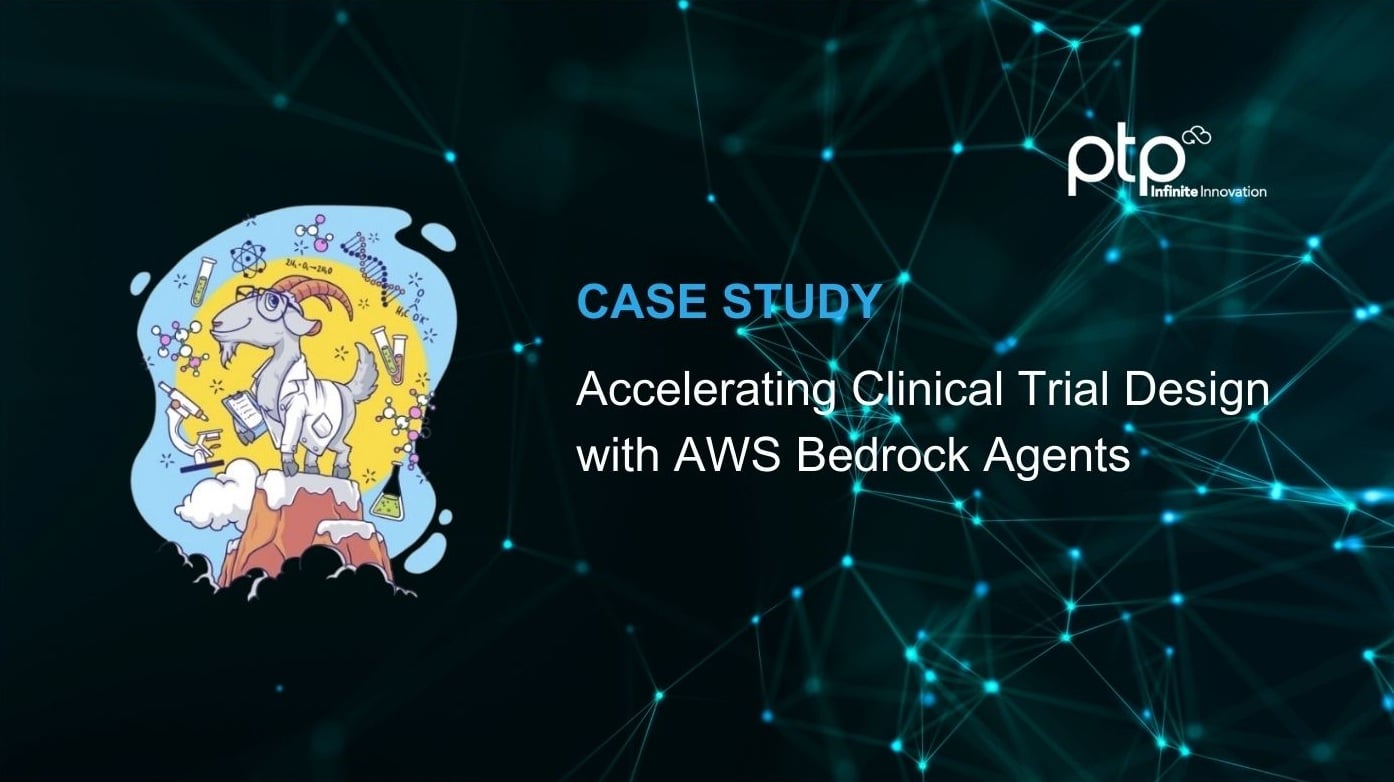





Take PTP's AI Readiness Assessment
We’ll evaluate your current IT operations to uncover inefficiencies, automation opportunities, and risks that could impact uptime or compliance. This AI readiness assessment is tailored for biotech, pharma, and clinical research teams, with recommendations aligned to HIPAA and GxP to help you scale securely and operate with confidence.
FAQs About AI in Life Sciences
What is generative AI in life sciences?
Generative AI in life sciences uses AI models to create, summarize, analyze, or transform information across research, clinical, and business workflows. Common examples include scientific literature review, protocol support, documentation assistance, knowledge management, and internal research copilots that help teams work faster with complex information.
What is agentic AI in life sciences?
Agentic AI in life sciences refers to AI systems that can take guided actions across workflows, tools, or data environments. For regulated life sciences organizations, agentic AI requires careful planning around permissions, security, validation, auditability, and human oversight before it is used in production.
How can biotech companies move AI from pilot to production?
Biotech companies can move AI from pilot to production by starting with a clear use case, preparing the right data foundation, choosing a secure cloud architecture, defining governance requirements, and measuring business or scientific outcomes. PTP helps life sciences teams design production-ready AI environments that support security, scalability, compliance alignment, and long-term operational support.
Why do life sciences AI projects fail?
Life sciences AI projects often fail because teams start with the technology before defining the problem, data quality, governance model, security requirements, or path to measurable value. AI projects are more likely to succeed when the use case is practical, the infrastructure is scalable, and the solution is designed for the realities of regulated research and clinical environments.
What infrastructure is needed for AI in life sciences?
AI in life sciences typically requires secure cloud infrastructure, reliable data pipelines, controlled access, storage designed for scientific data, monitoring, cost management, and governance controls. For many biotech and pharma teams, AWS provides the scalable foundation needed to support AI workloads, analytics, automation, and research collaboration.
How can life sciences companies prove AI ROI?
Life sciences companies can prove AI ROI by selecting focused use cases, defining measurable outcomes, tracking time savings or cost reductions, and connecting AI work to research, clinical, or operational improvements. For startups and growing biotech companies, the best AI projects are often the ones that solve a clear problem quickly and create a path to scalable value.