

Secure Azure Synapse Analytics Modernization for Biotech Data Workloads
PTP helped a biotech customer rebuild a public-facing Azure Synapse Analytics environment into a secure, scalable, and governed Azure analytics platform. The solution used private endpoints, network isolation, Azure-native security controls, SQL workload optimization, Azure Data Factory, Azure Databricks, Azure Blob Storage, Microsoft Defender for Cloud, Azure Monitor , RBAC, and diagnostic logging to improve security, performance, scalability, and operational efficiency.

Executive Summary
Biotech Customer IGMBio operating a publicly accessible Azure Synapse Analytics environment required a secure, scalable, and optimized analytics platform to support enterprise reporting and data processing workloads. The existing environment lacked proper security controls, cost optimization, and network isolation. The solution involved redesigning and rebuilding the analytics platform using secure Azure-native architecture principles, implementing private connectivity, optimizing SQL workloads, and migrating the analytics data ecosystem into a secure and governed cloud environment.Customer Profile: Biotech Azure Analytics Environment
The customer was a biotech organization operating an Azure-based analytics environment that supported enterprise reporting, data processing, SQL workloads, ETL orchestration, and cloud data storage. The environment included Azure Synapse Analytics, Azure Data Factory, Azure Databricks, Azure Blob Storage, and public internet-facing services that needed to be secured and modernized.
- Industry: Biotech
- Existing environment: Azure Synapse Analytics Workspace, Azure Data Factory, Azure Databricks, Azure Blob Storage, and SQL-based analytics workloads.
- Security concern: The analytics environment included public internet-facing services that needed stronger private connectivity, network isolation, and Azure-native security controls.
- Key business drivers: Improve cloud security posture, eliminate public internet exposure, optimize resource utilization, modernize the analytics platform architecture, and improve scalability and operational efficiency.
The Secure Azure Synapse Analytics Modernization Challenge
The biotech organization needed to secure and modernize an Azure Synapse Analytics environment that supported enterprise reporting and data processing workloads. The existing platform had public internet exposure, limited network isolation, insufficient security controls for Azure PaaS services, and SQL workloads that required right-sizing and optimization.
- Public internet exposure: The Azure Synapse Analytics workspace and related analytics services were accessible over the internet, creating unnecessary security risk for sensitive biotech data workloads.
- Limited private connectivity: The environment lacked private endpoint-based connectivity between Azure Synapse, Azure Data Factory, Azure Databricks, and Azure Blob Storage.
- Insufficient network isolation: The analytics platform needed stronger segmentation and secure communication between cloud services to reduce exposure and improve control.
- SQL workload optimization needs: Existing SQL-based analytics workloads required right-sizing to improve performance, stability, and cloud resource utilization.
- Governance and monitoring gaps: The environment needed standardized governance controls, RBAC, diagnostic logging, Azure Monitor, and Microsoft Defender for Cloud to improve operational visibility.
- Migration continuity requirements: The modernization needed to migrate analytics workloads with minimal downtime while maintaining application continuity, validation, and testing throughout the transition.
The Solution: Secure Azure Synapse Analytics Modernization
PTP designed and implemented a secure Azure analytics platform to modernize the customer’s Azure Synapse Analytics environment, eliminate public internet exposure, improve private connectivity, and strengthen governance across cloud data services. The solution used Azure-native security, networking, monitoring, and optimization services to support enterprise reporting and data processing workloads.
Secure Azure Analytics Architecture
The architecture rebuilt the analytics environment around private endpoint-based access, segmented networking, secure service communication, and Azure-native security controls. Azure Synapse Analytics, Azure Data Factory, Azure Databricks, and Azure Blob Storage were connected through a more secure and governed cloud architecture designed to reduce exposure and improve operational visibility.

Core Architecture Elements
- Azure Synapse Analytics workspace secured through private network access.
- Private endpoints used to reduce public internet exposure across analytics services.
- Azure Data Factory enabled secure ETL orchestration and data movement.
- Azure Databricks supported secure analytics compute and controlled data access.
- Azure Blob Storage provided secure cloud storage with private endpoint integration.
- Azure Firewall helped control traffic and protect the analytics environment.
- Microsoft Defender for Cloud, Azure Monitor, RBAC, and diagnostic logging improved governance, visibility, and security posture.
Key Azure Components
The solution combined Azure analytics, security, networking, monitoring, and governance services to create a scalable and secure platform for biotech data processing, reporting, and analytics workloads.
- Azure Synapse Analytics: Delivered the secure analytics workspace and supported optimized SQL-based analytics workloads.
- Private Endpoints: Enabled private connectivity between Azure services and reduced public internet exposure.
- Azure Data Factory: Supported secure ETL orchestration and controlled data movement across the analytics platform.
- Azure Databricks: Provided secure compute for advanced analytics and data processing workloads.
- Azure Blob Storage: Supported secure cloud storage, private access, and data lifecycle management.
- Microsoft Defender for Cloud: Improved cloud security posture and threat visibility across Azure resources.
- Azure Monitor and diagnostic logging: Provided operational visibility, logging, and performance monitoring.
- RBAC: Helped enforce role-based access control and standardized governance.
Implementation Approach: Secure, Optimize, Migrate, Validate
PTP followed a structured modernization approach to secure the Azure Synapse Analytics environment, optimize SQL workloads, migrate analytics services, and validate performance. This approach helped the customer improve security and scalability while maintaining continuity for reporting and data processing workloads.
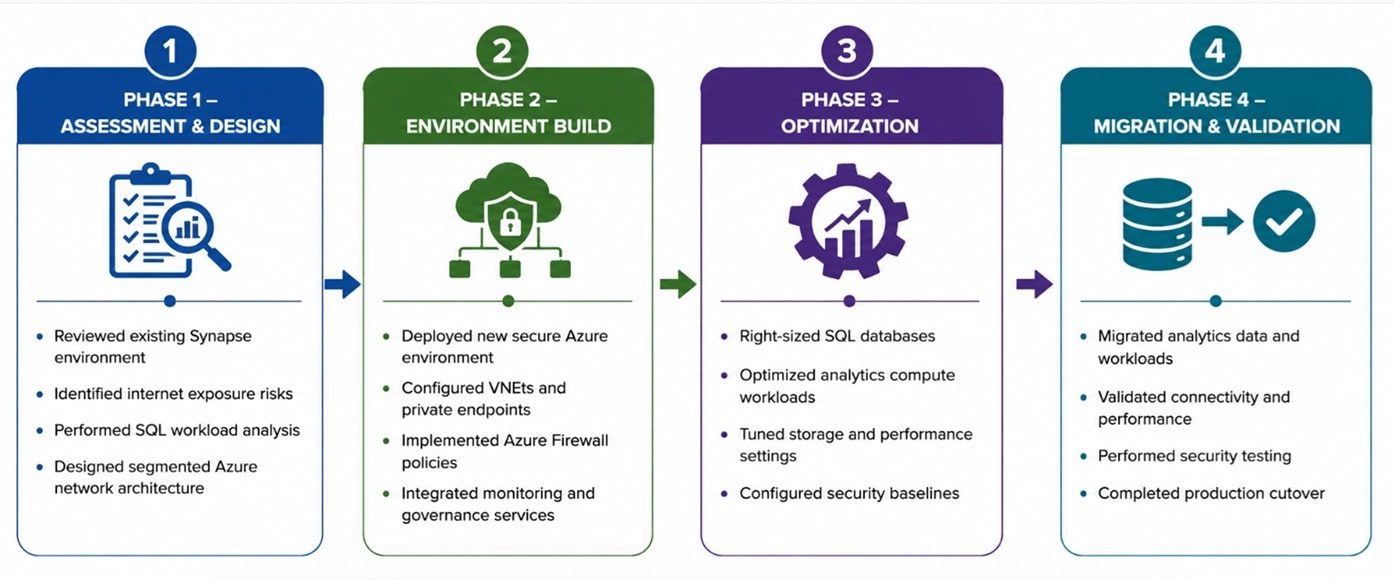
Modernization Phases
- Architecture redesign: Rebuilt the analytics environment using segmented Azure architecture and secure communication patterns.
- Private connectivity: Implemented private endpoints for Azure Synapse Analytics, Azure Data Factory, Azure Databricks, and Azure Blob Storage.
- Security hardening: Enabled Azure-native security controls, RBAC, diagnostic logging, Microsoft Defender for Cloud, and Azure Firewall.
- SQL workload optimization: Right-sized and optimized SQL-based analytics workloads to improve performance, stability, and cost efficiency.
- Analytics workload migration: Migrated data processing and reporting workloads into the secure Azure analytics environment.
- Validation and testing: Validated connectivity, access controls, workload performance, logging, monitoring, and application continuity after migration.
Secure Azure Synapse Analytics Modernization Outcomes
The Azure Synapse Analytics modernization helped the biotech organization reduce security risk, improve private connectivity, optimize cloud resource utilization, and create a more governed analytics platform for enterprise reporting and data processing workloads.
- Eliminated public internet exposure: Private endpoint-based connectivity helped secure Azure Synapse Analytics and related Azure data services from unnecessary public access.
- Enabled private connectivity across analytics services: Azure Synapse Analytics, Azure Data Factory, Azure Databricks, and Azure Blob Storage were connected through a more secure internal access model.
- Improved cloud security posture: Azure-native security controls, RBAC, Microsoft Defender for Cloud, Azure Firewall, and diagnostic logging strengthened protection and visibility.
- Reduced cloud operational costs: SQL workload right-sizing and resource optimization helped improve cost efficiency across the analytics environment.
- Improved scalability and workload stability: The modernized Azure analytics architecture provided a stronger foundation for enterprise reporting, data processing, and future growth.
- Strengthened governance and monitoring: Azure Monitor, diagnostic logging, RBAC, and standardized security controls improved operational visibility and governance across the platform.
Why PTP for Secure Azure Synapse Analytics Modernization
Securing Azure Synapse Analytics requires more than closing public access. PTP helps organizations redesign analytics platforms with private connectivity, segmented architecture, Azure-native security controls, workload optimization, monitoring, and governance built into the environment from the start.
- Security-first Azure analytics design: PTP implemented a private endpoint-based analytics architecture to reduce exposure and secure communication between Azure data services.
- Deep Azure analytics modernization expertise: The solution brought together Azure Synapse Analytics, Azure Data Factory, Azure Databricks, Azure Blob Storage, SQL workload optimization, and secure cloud networking.
- Optimization-focused implementation: PTP helped right-size SQL workloads and improve resource utilization to support better performance, stability, and cloud cost efficiency.
- Governance and monitoring framework: Microsoft Defender for Cloud, Azure Monitor, RBAC, diagnostic logging, and Azure Firewall helped create a more visible and governed analytics environment.
- Secure operational model for analytics workloads: The modernized platform supported internal-only access, improved control, and a more scalable foundation for biotech reporting and data processing.

Ready to Strengthen Your Azure Environment?
PTP helps organizations improve Azure performance, security, governance, and cost efficiency through practical cloud assessments and prioritized remediation planning.Schedule your free consultation today.
Tell us a bit about your project to get started with PTP. Fill out the form below and our team will be in touch shortly.
FAQs About Secure Azure Synapse Analytics Modernization
What is secure Azure Synapse Analytics modernization?
Secure Azure Synapse Analytics modernization is the process of redesigning and rebuilding an Azure Synapse Analytics environment to improve security, scalability, performance, governance, and operational efficiency. This can include private endpoints, network isolation, SQL workload optimization, Azure-native security controls, monitoring, diagnostic logging, and secure connectivity across Azure data services.
Why should Azure Synapse Analytics use private endpoints?
Azure Synapse Analytics should use private endpoints to reduce public internet exposure and support secure private connectivity between Azure services. Private endpoint-based access helps protect analytics workspaces, data pipelines, storage accounts, and data processing workloads by keeping communication within a controlled Azure network architecture.
How can public internet exposure be removed from Azure analytics services?
Public internet exposure can be removed from Azure analytics services by using private endpoints, segmented networking, Azure Firewall, RBAC, diagnostic logging, and Azure-native security services. For Azure Synapse Analytics, Azure Data Factory, Azure Databricks, and Azure Blob Storage, this approach helps create a secure internal-only access model.
What Azure services are used in secure analytics modernization?
A secure Azure analytics modernization project can include Azure Synapse Analytics, Azure Data Factory, Azure Databricks, Azure Blob Storage, private endpoints, Azure Firewall, Microsoft Defender for Cloud, Azure Monitor, RBAC, diagnostic logging, and SQL workload optimization. These services help secure, govern, monitor, and scale enterprise analytics workloads.
How does SQL workload optimization improve Azure Synapse Analytics?
SQL workload optimization improves Azure Synapse Analytics by right-sizing resources, improving query performance, reducing inefficient utilization, and supporting better cloud cost control. Optimizing dedicated SQL pools and analytics workloads can improve workload stability, reporting performance, scalability, and operational efficiency.
How does PTP support secure Azure Synapse Analytics modernization?
PTP supports secure Azure Synapse Analytics modernization by redesigning Azure analytics environments with private connectivity, segmented architecture, SQL workload optimization, Azure-native security controls, monitoring, governance, and validation. For this case study, PTP helped a biotech customer eliminate public internet exposure, secure Azure Synapse Analytics, improve private connectivity, and modernize analytics workloads across Azure Data Factory, Azure Databricks, and Azure Blob Storage.