

Azure Cloud Assessment and Optimization with the Microsoft Well-Architected Framework
Azure cloud assessment and optimization helps organizations improve performance, strengthen security, reduce unnecessary spend, and build a more reliable governance model across growing Microsoft Azure environments. Using the Microsoft Well-Architected Framework, PTP helps identify cloud risks, uncover cost optimization opportunities, and create a practical roadmap for a more secure, resilient, and efficient Azure platform.

Executive Summary
As organizations continue to scale their cloud environments, maintaining performance, security, governance, and cost control becomes increasingly complex. Many businesses adopt Microsoft Azure to accelerate innovation, but over time cloud environments can become difficult to manage, resulting in unnecessary costs, security risks, and operational inefficiencies.
To help organizations maximize the value of their Azure investments, PTP recently conducted a comprehensive Azure Well-Architected Framework Review (WAFR) for a customer seeking to improve cloud reliability, strengthen security, optimize spending, and establish a stronger governance model.
The Challenge
Like many growing organizations, the customer had built a mature Azure environment consisting of multiple subscriptions, production and non-production workloads, virtual machines, networking services, storage platforms, databases, monitoring tools, and backup solutions.
While the environment supported critical business operations, several challenges had emerged:
Reliability Concerns
- Single points of failure within key workloads
- Inconsistent backup configurations
- Limited disaster recovery planning
- Lack of resiliency testing and validation
Security Risks
- Excessive privileged access
- Inconsistent role-based access control (RBAC)
- Missing multi-factor authentication (MFA) enforcement
- Publicly exposed resources
- Gaps in monitoring and alerting capabilities
Rising Cloud Costs
- Oversized virtual machines
- Idle resources consuming unnecessary spend
- Unused storage accounts and managed disks
- Limited use of Reserved Instances
- Lack of budget monitoring and cost visibility
Operational Challenges
- Manual deployment processes
- Inconsistent resource tagging
- Limited governance controls
- Lack of standardized operational procedures
Performance Limitations
- Resource bottlenecks impacting application performance
- Inefficient storage configurations
- Underutilized scaling capabilities
- Limited workload monitoring and optimization
The organization needed a structured approach to assess its cloud maturity and identify opportunities for improvement across the entire Azure platform.
The Solution: Azure Well-Architected Framework Review
PTP conducted a comprehensive Azure Well-Architected Framework Review using Microsoft's proven assessment methodology.
The engagement included
- Workload discovery and inventory assessment
- Architecture review workshops
- Azure Advisor analysis
- Security posture evaluation
- Cost optimization review
- Reliability and resiliency assessment
- Operational excellence evaluation
- Performance efficiency analysis
- Development of a prioritized remediation roadmap
This approach provided clear visibility into risks, optimization opportunities, and strategic recommendations aligned with Microsoft's cloud best practices.
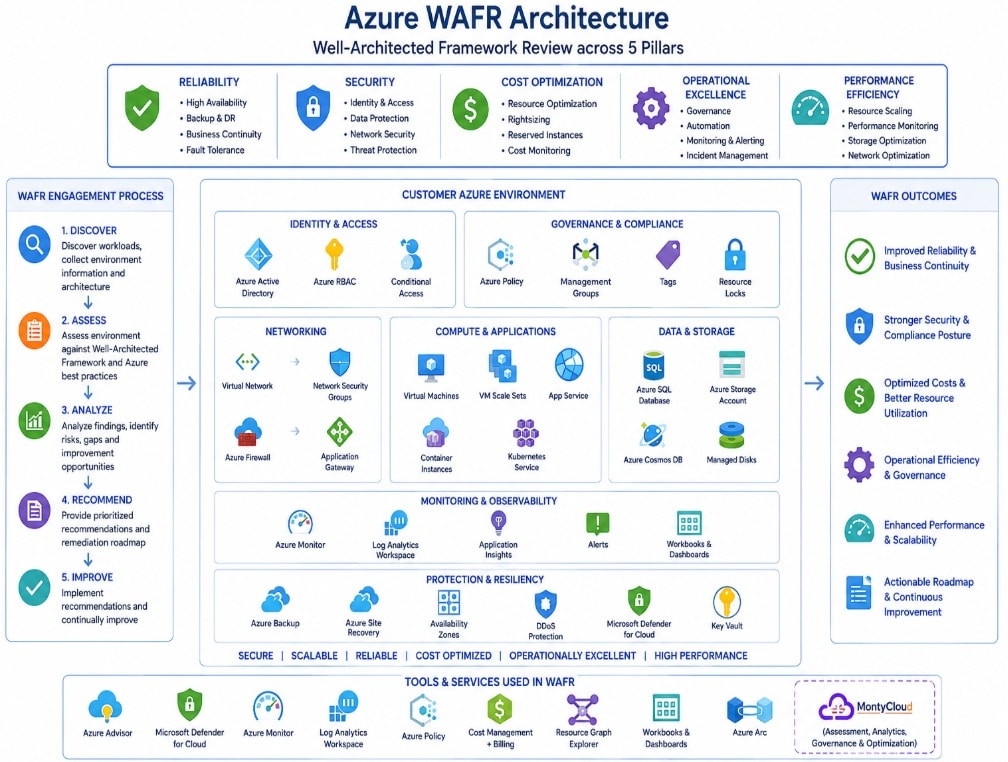
Azure WAFR architecture overview showing the five pillars, Azure environment components, engagement process, and business outcomes.
Evaluating the Five Pillars of Azure Success
The assessment focused on Microsoft's five core Well-Architected Framework pillars:
| Pillar | Objective | Key Findings | Recommendations |
|---|---|---|---|
| Reliability | Ensuring workloads remain available and recoverable during outages or disruptions. |
|
|
| Security | Protecting workloads, identities, and data from evolving threats. |
|
|
| Cost Optimization | Maximizing business value while minimizing cloud waste. |
|
|
| Operational Excellence | Creating repeatable, scalable operational processes. |
|
|
| Performance Efficiency | Ensuring workloads can scale and perform efficiently. |
|
|
Azure Well-Architected Framework Review key findings and recommendations across reliability, security, cost optimization, operational excellence, and performance efficiency.
A Structured Path to Optimization
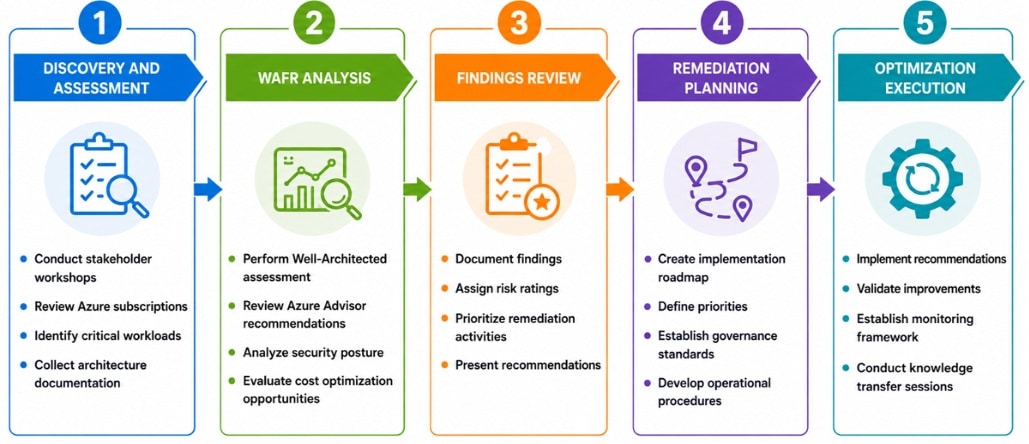
To ensure recommendations could be effectively implemented, PTP developed a phased optimization roadmap:
Phase 1: Discovery & Assessment
Document workloads, architecture, dependencies, and business objectives.
Phase 2: WAFR Analysis
Evaluate the environment against Microsoft Well-Architected Framework standards.
Phase 3: Findings Review
Present risks, opportunities, and business impacts.
Phase 4: Remediation Planning
Prioritize recommendations based on business value and implementation effort.
Phase 5: Optimization Execution
Implement improvements and establish ongoing governance practices.
Results and Business Impact
The Azure Well-Architected Framework Review delivered actionable insights that enabled the customer to strengthen its cloud environment and create a roadmap for continuous improvement.
| Outcome Area | Business Impact |
|---|---|
| Reliability Improvements |
|
| Security Enhancements |
|
| Operational Improvements |
|
| Performance Gains |
|
| Cost Optimization Opportunities |
The assessment identified significant opportunities to reduce Azure spending through:
Estimated cloud cost savings ranged from 15% to 35% while maintaining or improving performance and reliability. |
Why Organizations Choose PTP for Azure Assessments
PTP combines deep Azure expertise with practical business-focused recommendations that help organizations maximize cloud investments.
Our approach includes:
- Microsoft Azure Well-Architected Framework expertise
- End-to-end cloud architecture assessments
- Security and governance best practices
- FinOps and cloud cost optimization strategies
- Disaster recovery and resiliency planning
- Operational excellence frameworks
- Business-prioritized remediation roadmaps
- Alignment with Microsoft's Cloud Adoption Framework (CAF) and Azure Landing Zone principles
Conclusion
Cloud environments are never truly finished. As organizations grow, workloads evolve, and business requirements change, continuous assessment becomes critical to maintaining a secure, reliable, and cost-effective cloud platform. By leveraging Microsoft's Azure Well-Architected Framework, organizations gain a clear understanding of their current cloud maturity, identify opportunities for improvement, and establish a roadmap for long-term success. The result is a more resilient, secure, scalable, and financially optimized Azure environment that supports both current business objectives and future growth.

Ready to Strengthen Your Azure Environment?
PTP helps organizations improve Azure performance, security, governance, and cost efficiency through practical cloud assessments and prioritized remediation planning.
Schedule your free consultation today.
Tell us a bit about your project to get started with PTP. Fill out the form below and our team will be in touch shortly.
FAQs About Azure Cloud Assessment and Optimization
What is an Azure Well-Architected Framework Review?
An Azure Well-Architected Framework Review is a structured assessment of a cloud environment based on Microsoft best practices for reliability, security, cost optimization, operational excellence, and performance efficiency. It helps organizations understand cloud maturity, identify risks, and prioritize improvements across Azure workloads, subscriptions, and supporting services.
Why do organizations need an Azure cloud assessment?
Organizations need an Azure cloud assessment when their environments become more complex and harder to manage over time. An assessment helps uncover security gaps, cost inefficiencies, governance issues, backup and disaster recovery weaknesses, and performance bottlenecks that can affect business operations and long-term cloud value.
What does the Microsoft Well-Architected Framework evaluate?
The Microsoft Well-Architected Framework evaluates five core pillars of Azure success: reliability, security, cost optimization, operational excellence, and performance efficiency. Reviewing each pillar helps organizations measure how well their Azure environment supports availability, protection, governance, cloud spending, and workload performance.
How can an Azure assessment improve cloud cost optimization?
An Azure assessment can improve cloud cost optimization by identifying oversized virtual machines, idle resources, underused Reserved Instance opportunities, storage inefficiencies, and limited budget visibility. These findings help organizations reduce unnecessary Azure spend while maintaining or improving workload performance and reliability.
What types of issues can an Azure architecture review uncover?
An Azure architecture review can uncover single points of failure, inconsistent backup configurations, weak disaster recovery planning, excessive privileged access, missing MFA enforcement, public exposure risks, manual deployment workflows, weak tagging strategies, governance gaps, and performance limitations across applications and infrastructure.
What should organizations expect after an Azure Well-Architected review?
After an Azure Well-Architected review, organizations should expect a clearer picture of risks, optimization opportunities, and business impacts, along with a prioritized remediation roadmap. The goal is to create a practical path toward a more secure, reliable, scalable, and cost-efficient Azure environment supported by stronger governance and operational processes.